Browse Exhibits (2 total)
Black African Nations Toward Unity
In the spring of 1972, Black Panther leader Bob Heard began teaching a Black history course in Walpole, with the assistance of Harvard undergraduate David Dance. The students in this class would eventually form Black African Nations Toward Unity (BANTU). In this class, they studied the works of poets and musicians including The Last Poets, Nikki Giovanni, Sonia Sanchez, Etheridge Knight, Frederick Douglass, James Brown, Curtis Mayfield, Gil Scott Heron, Bob Marley, Jimmy Cliff, and Sly and the Family Stone. Building on the cultural, intellectual, and political framework provided by the class, BANTU, officially established on September 1, 1972, was the first Black cultural organization in the Massachusetts prison system. Its members understood “the unique way the penal system had been built not only to oppress them, but to re-enslave them” (Bissonette 72). The groups cultivation of Black consciousness also helped develop solidarity within Walpole’s Black population and contributed to…
The National Prisoners Reform Association (NPRA)
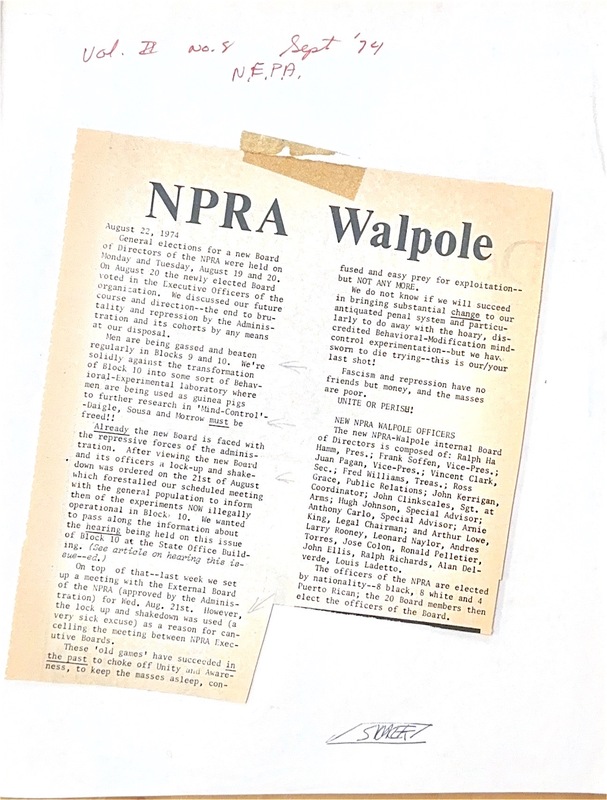
The Walpole branch of the National Prisoners Reform Association (NPRA) was a labor union formally established by those incarcerated in Walpole on September 1, 1972. At Walpole, and in Massachusetts at large, the NPRA consisted entirely of prisoners and negotiated power using a workers’ rights framework combined with bargaining-unit recognition granted by the Department of Corrections. Fundamentally, it united the prisoners of Walpole as laborers who were entitled to certain rights “allow[ing] for mutual accountability and self-development” (78).
In an interview with Jamie Bissonette, Robert Dellelo describes how, soon before the formation of the NPRA-Walpole chapter, he invoked this sense of cross-racial labor solidarity in an address to his fellow prisoners:
I said, ‘There is only one color and that is blue.’ The guards wore khaki, which was brown; the prisoners were wearing blue. It was blue versus brown. ‘You are either blue or brown. There is no in-between ground. We are all in…