The NPRA: A Timeline
For a more general timeline of the events at Walpole, see the Archive Overview.
Summer, 1972: Robert Dellelo and Ralph Hamm begin developing the Walpole chapter of the NPRA as a means to demonstrate the viability of prison abolition. In the process, prisoners of color, particularly BANTU, work to ensure that they are represented on its board. Ultimately, the board consisted of nine Black, nine white, and three “Spanish” men.
August, 1972:
- The NPRA’s final structure is determined. Racial equity is maintained in the creation of its executive board, which consisted of two Black, two white, and one Puerto Rican prisoner.
- The prisoners elect the NPRA over the Inmate Advisory Council to represent them in negotiations with the administration.
- Prisoners vote on the NPRA’s board, which creates fifteen subcommittees that develop the inner workings of Walpole with the goal of helping prisoners “exercise self-determination” and “demonstrate that the prison itself was unnecessary” (89).
- 80% of Walpole’s prisoners sign unionization cards, and the NPRA meets with attorneys to discuss the process of getting official recognition as a union.
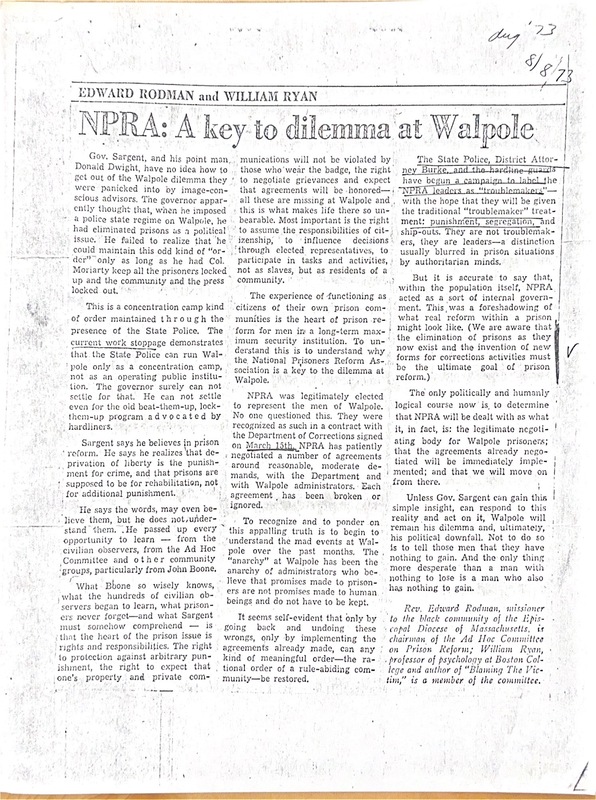
September 1, 1972: The NPRA is officially established.
December 29, 1972: Angered by Superintendent Porelle’s disruption of BANTU’s Kwanzaa celebration, the prisoners instate a strike in which they remain in their cells and refuse to work.
January 31, 1973: The NPRA’s petition for recognition as a collective-bargaining unit is referred to the State Labor Relations Commission (SLRC), marking the first time in U.S. history that a labor board agreed to consider whether to recognize prisoners as employees.
Late February, 1973: The NPRA releases a “Manifesto of Dehumanization” that details the features of Walpole that work to dehumanize its prisoners. These include the disbandment of self-help programs, removing men from their cells in the middle of the night and moving them to maximum security without explanation, and the taking away of donated books. The manifesto is signed by BANTU board of directors chairman Solomon Brown, demonstrating that BANTU had taken over the NPRA.
February 22, 1973: The NPRA demands the removal of Superintendent Porelle.
February 26, 1973: The NPRA voices twelve grievances/demands regarding visits, amnesty, avocation, groups, canteen, privileges, new men, death row, restoration, press, counts, and bulletins.
March 7, 1973: Following Porelle’s resignation, the NPRA ends the strike begun on December 29, begins cleaning the prison, and enters negotiations with acting superintendent Kenneth Bishop. This marks the NPRA’s first concrete win.
March 8, 1973: The first round of civilian observers enter Walpole.
March 9, 1973: In response to the presence of observers, fifty guards refuse to punch in for the three o’ clock shift change; the entire shift eventually walks off the job. There are no guards in the prison.
March 10 - 18, 1973:
- Kenneth Bishop recognizes the NPRA as the prisoners’ bargaining unit.
- Though the SLRC has already decided not to certify the union, this recognition pushes them to delay releasing this decision until September. As such, the NPRA proceeds under the impression that they could gain recognition as long as they demonstrated their strength as a labor union.
March 19, 1973: The Massachusetts supreme court orders the guards to return to their posts, leading the guards to come back to Walpole, but not to the individual cell blocks. The NPRA maintains its responsibility for program, industry, culture, and conflict resolution.
March 15 - May 18, 1973: The NPRA maintains peace within Walpole.
May 18, 1973:
- The prisoners receive notice that there will be a lockup and shakedown on May 21. The NPRA board has not been consulted regarding this memo, and it does not acknowledge any of their demands.
- The NPRA has an emergency meeting with the general population, during which the board tells everyone to refrain from violence.
- Robert Dellelo contacts acting superintendent Walter Waitkevich regarding the prisoners’ concerns. Eventually, Waitkevich agrees to meet with the NPRA leadership about the men’s demands regarding the shakedown (i.e. retention of visitation, no extended lockdown, access to showers). However, Waitkevich refuses to concede.
- The NPRA spends the rest of the night committing to a strategy of nonviolence.
May 19, 1973:
- Waitkevich calls in law enforcement to surround the prison.
- The gates between the minimum and maximum ends close, trapping several prisoners “out of place.”
- Walpole is thrown into chaos, including much yelling and a fire in the chaplain’s office.
- Waitkevich orders for the press and civilian observers to leave.
- A bit before eight in the morning, Waitkevich announces that police have entered the prison and orders everyone to return to their cells. The police soon enter in riot gear, patrolling the prison, taking men from their cells, and beating them. The NPRA’s papers are destroyed in the shakedown.
- Still, after the cells are reopened, the prisoners continue their jobs, demonstrating their sense of ownership over and responsibility for the prison.